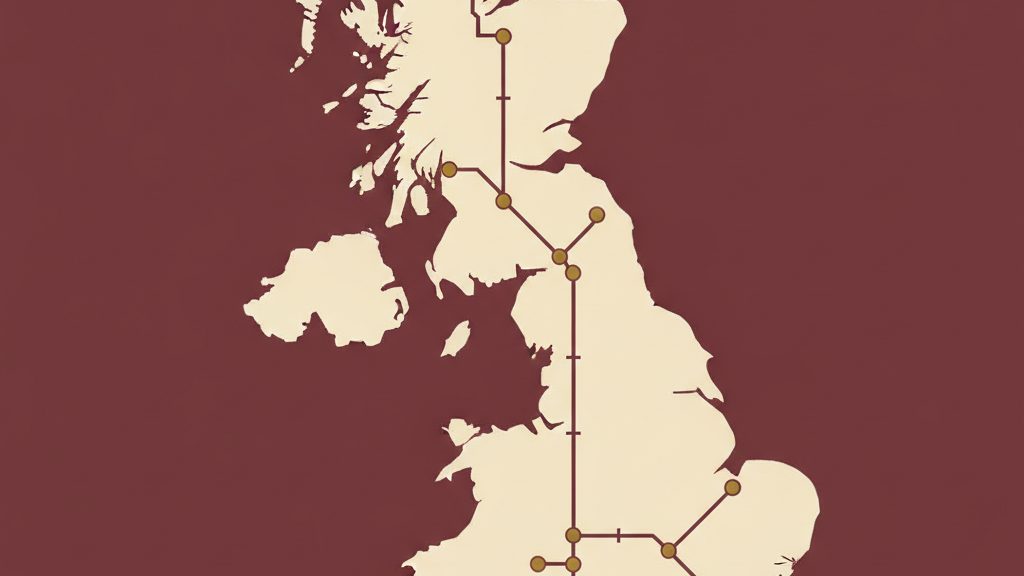
Nationalisation on 1 January 1948 brought the Big Four companies, the Great Western, the London Midland and Scottish, the London and North Eastern, and the Southern, into a single undertaking. British Railways organised the inherited network into six operating regions. Each region kept much of its predecessor’s character in motive power, coaching stock, and signalling practice well into the 1960s. This is where the archive begins: pick a region, then a constituent, then a line.
The regional map on this page describes the network as it was worked in 1960: the last full year before the Reshaping Report, and near the end of front-line steam. British Railways abolished the regional structure in 1982. The regions are treated here as historical, named as they were named at the time.
The six regions
Western Region
Western Region
Successor to the Great Western Railway. Headquartered at Paddington, working the road to Bristol, Plymouth, and Penzance behind Kings and Castles, with chocolate-and-cream coaches surviving on named expresses.
London Midland Region
London Midland Region
Successor to the LMS south of the border. The West Coast Main Line spine from Euston, the Midland Main Line from St Pancras, Black Fives on everything, and the Coronations on the Up Royal Scot.
Eastern Region
Eastern Region
The southern two-thirds of the former LNER, from Kings Cross and Liverpool Street. Gresley and Peppercorn Pacifics on the East Coast Main Line, and the Great Eastern main line into East Anglia.
North Eastern Region
North Eastern Region
The former LNER north-eastern area, based on York and Newcastle. The old North Eastern Railway heartland, heavy on coal traffic, and home to the East Coast racing ground north of Doncaster.
Scottish Region
Scottish Region
All railways in Scotland, drawn from both LMS and LNER operations north of the border. The West Highland, the Waverley Route, and the Perth and Aberdeen roads, from Glasgow and Edinburgh.
Southern Region
Southern Region
Successor to the Southern Railway. The most heavily electrified region, on 660-volt third rail out of Waterloo, Victoria, and Charing Cross, with Bulleid Pacifics on the West of England road.
Before the regions: the constituents
Each region inherited a network built by the pre-1948 companies, and before them by the pre-1923 constituents grouped into the Big Four. The constituents section traces that lineage: the Great Western, the London Midland and Scottish, the London and North Eastern, and the Southern, and the older companies they absorbed, from the London and North Western and the Midland to the Caledonian and the Highland.
How the regions changed
The boundaries were not fixed. In 1958 British Railways redrew regional boundaries on a broadly geographical basis, so that lines were worked by the region through whose territory they ran rather than by the region that had inherited them from the Big Four. The North Eastern Region was merged into the Eastern Region on 1 January 1967. The regional tier was abolished in 1982 under the sector-management reorganisation. Throughout this archive the six-region structure is described as it stood in 1960.
- Awdry, C. (1990) Encyclopaedia of British Railway Companies, Patrick Stephens Ltd.
- Body, G. (1989) PSL Field Guide: Railways of the Western Region and companion regional volumes.
- British Railways regional boundary revisions, 1950 and 1958, as summarised in Awdry.