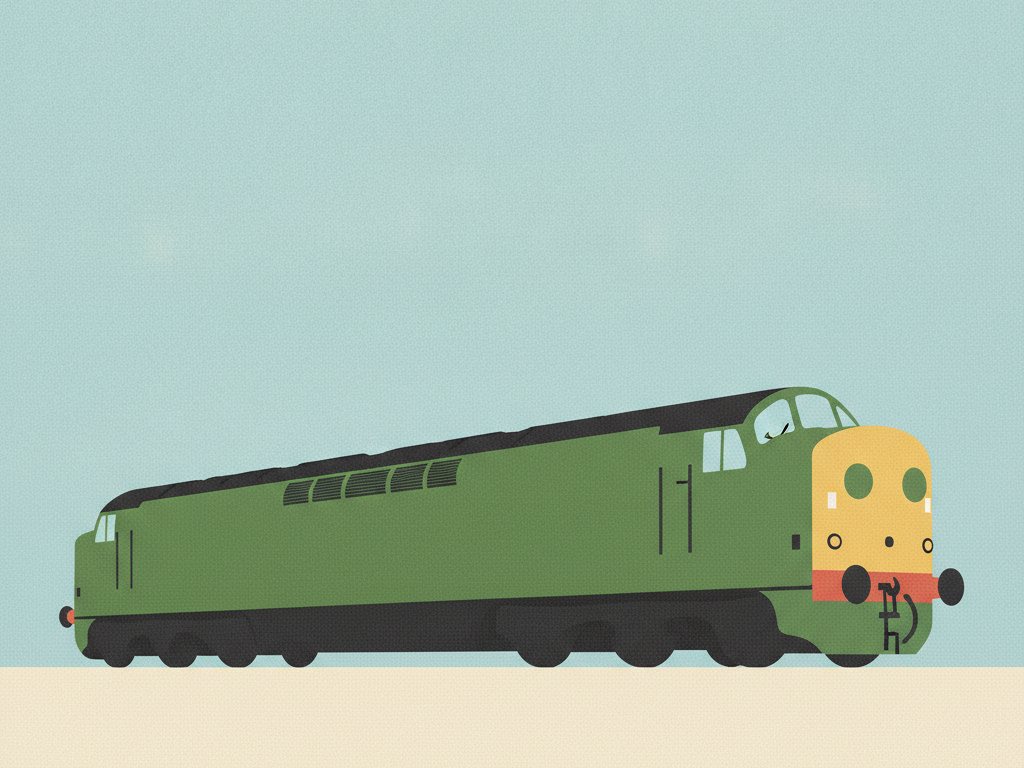
Listed in a 1960 Ian Allan ABC as the English Electric Type 4, and known under TOPS as the Class 40, these were among the first main-line diesels British Railways put to work on its principal express routes. English Electric built 200 of them between 1958 and 1962, numbered D200 to D399.
Design and build
The class was ordered under the modernisation plan as a Type 4 diesel-electric, carried on a 1Co-Co1 wheel arrangement in which a leading and trailing carrying axle spread the weight at each end of the bogies. Power came from an English Electric 16SVT engine of about 2,000 horsepower. English Electric built all 200 between 1958 and 1962.
In service
As some of the first main-line diesels, they took over principal expresses on the West Coast Main Line before its electrification, on the East Coast Main Line, and on the Great Eastern main line to Norwich. Crews and enthusiasts nicknamed them “whistlers” for the distinctive turbocharger noise. As more powerful designs arrived, the class was displaced to secondary and freight duties, latterly concentrated in the north-west of England.
Numbering
The 200 locomotives were numbered D200 to D399. Under the TOPS renumbering scheme the type became Class 40, and survivors were given five-figure numbers in that series.
Withdrawal and preservation
Withdrawal ran through the 1970s and early 1980s, and the class was gone from British Rail service by the mid-1980s. Seven have been preserved, among them the pioneer D200, later numbered 40122, which forms part of the national collection.
If a figure here is wrong or you can add an allocation detail, please tell us. Corrections are logged publicly.
- Ian Allan ABC of British Railways Locomotives, Combined Volume, diesel section.
- Standard BR diesel class histories, e.g. Marsden.
- The Class Forty Preservation Society.